 The
amusement season is quickly winding down as daily operation (for seasonal
parks) comes to a close and schools go back into session. Like schools, legislatures around the country
will also be heading into session shortly and, given the tragic and unfortunate
incidents in the amusement industry recently, it is likely that at least
some of these – maybe even at the federal level – will consider new regulation
of the industry. As I’ve detailed before
in my last two pieces, the siren song of federal regulation is almost
impossible to ignore in the wake of an amusement ride-related death or serious
injury. But the only real reason to look
seriously at replacing the current system with a new federal oversight program
is if the states' regulatory programs are not working. So, for my final piece in this series I
thought it would make sense to look at the evidence, or lack thereof, that
state regulation is failing.
The
amusement season is quickly winding down as daily operation (for seasonal
parks) comes to a close and schools go back into session. Like schools, legislatures around the country
will also be heading into session shortly and, given the tragic and unfortunate
incidents in the amusement industry recently, it is likely that at least
some of these – maybe even at the federal level – will consider new regulation
of the industry. As I’ve detailed before
in my last two pieces, the siren song of federal regulation is almost
impossible to ignore in the wake of an amusement ride-related death or serious
injury. But the only real reason to look
seriously at replacing the current system with a new federal oversight program
is if the states' regulatory programs are not working. So, for my final piece in this series I
thought it would make sense to look at the evidence, or lack thereof, that
state regulation is failing. 
About Me

- Erik H. Beard, Esq.
- I am a consultant and general counsel to International Ride Training LLC as well as a practicing attorney in Avon, Connecticut. A particular focus of mine is the legal needs of the amusement and tourism industry. My focus on the amusement industry derives from my pre-law career as an operations manager with Cedar Fair Entertainment Company and Universal Orlando. Having started my career as a ride operator at Cedar Point in 1992, I progressed through the seasonal ranks and ultimately became the Manager of Ride Operations and Park Services at Worlds of Fun in Kansas City. I also worked in Universal's operations department during the construction and development of Islands of Adventure. Today, I am an active member of the New England Association of Amusement Parks & Attractions and the International Association of Amusement Parks & Attractions. I have been invited to speak at amusement industry meetings and seminars and have worked on a variety of matters relating to this industry.
Showing posts with label legislation. Show all posts
Showing posts with label legislation. Show all posts
Tuesday, August 30, 2016
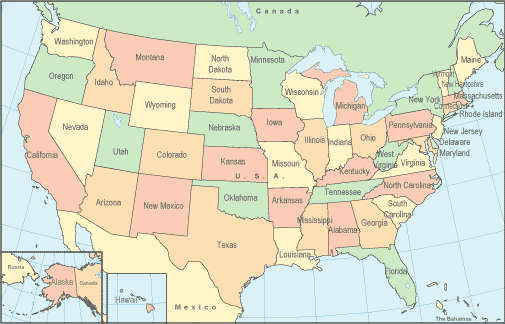
A Safer Ride? (Pt. 3) - Is State Amusement Regulation The Problem?
The
amusement season is quickly winding down as daily operation (for seasonal
parks) comes to a close and schools go back into session. Like schools, legislatures around the country
will also be heading into session shortly and, given the tragic and unfortunate
incidents in the amusement industry recently, it is likely that at least
some of these – maybe even at the federal level – will consider new regulation
of the industry. As I’ve detailed before
in my last two pieces, the siren song of federal regulation is almost
impossible to ignore in the wake of an amusement ride-related death or serious
injury. But the only real reason to look
seriously at replacing the current system with a new federal oversight program
is if the states' regulatory programs are not working. So, for my final piece in this series I
thought it would make sense to look at the evidence, or lack thereof, that
state regulation is failing. 

Monday, August 22, 2016
A Safer Ride? (Pt. 2) - What Would Federal Amusement Ride Regulation Cost & Do Regulators Even Want It?

The question of federal
oversight of amusement ride safety is one that comes up every summer in the
wake of an unfortunate, sometimes tragic, incident in the industry. But while many in politics and the media are
quick to speak out in favor of federal ride safety oversight, this rhetoric is
typically devoid of any detail. What
would a federal ride safety program look like?
What would it cost? And does the
agency that would be charged with administering it share the view that it would
be a good idea? In my last post, I made
my case for why I just do not see the federal government being any better (and
perhaps it would be worse) than the states when it comes to ride safety
oversight. But even setting that aside,
it is important to think about the details here and consider whether this
program might be not enough bang and too much buck.
Saturday, March 21, 2015
IAAPA’s First Virtual Advocacy Day Is Here! And We Need Your Support!

This week, IAAPA’s North American Government Relations
Subcomittee will be on Capitol Hill for its annual Advocacy Day (the name is
actually something of a misnomer, since it actually takes place over two days). On Tuesday and Wednesday, March 24-25,
twenty-three members of the committee (including me) as well as invited guests
from other IAAPA committees and members of the industry, will be meeting with
elected officials in the House and Senate, their staffs, the Commissioner of
the Consumer Product Safety Commission, and other government officials to
communicate the industry’s interests to those that shape federal policy. In all, we have scheduled thirty-six
legislative meetings, including meetings with seventeen members of
Congress, in only two days.
This year, IAAPA’s Government Relations Department, as well
as the North American Government Relations Subcommittee, is asking for your
help to make Advocacy Day 2015 an even bigger success than it usually is. In addition to our physical presence on the
Hill this week, we are asking you to take part in the first-ever Virtual Advocacy Day! What’s that, you ask? Well, while we are meeting face-to-face with
members of Congress and other policy-makers in Washington, we want you to take
to social media with the hashtag “#IAAPAVAD”
to amplify the messages that Advocacy Day attendees are bringing to DC. Tweet your Senators! Tweet your Representatives! Tweet the CPSC, the State Department, the
Transportation Department, the FAA! Show
them that you care about the industry and the issues that affect it.
So, what are the issues that we will be addressing over the
next few days and how can you help? Well, keep reading to find out more about our priority issues and how you can contact your representatives and policy makers.
Sunday, February 22, 2015
Do Height Requirements On Rides Violate The ADA?
 A couple of weeks ago, I had the privilege of spending a
couple days with a highly talented group of amusement professionals at the iROC
Safety School in Las Vegas. This is the
second year that I have been invited to speak at the event, and it is quickly
becoming a highlight of the year. The
topic of both this year’s and last year’s presentations was the Americans With
Disabilities Act which, as faithful readers of this blog know, is a particular
passion of mine. After a 90 minute
seminar on ride access last year, much of the Q&A session revolved around
the issue of autism which, coupled with the filing of the lawsuit against
Disney, prompted me to take a closer look at the issue in the “Here & Now”
series. This year, I came to iROC ready
to go on the issue of autism, but interestingly a new issue reared its head
that I hadn’t thought a whole lot about before: The question of height
requirements and, specifically, whether enforcing a height requirement against
a guest with a disability violates the ADA.
So, as with the autism issue last year, I thought this deserved a little
more thought and some attention here.
A couple of weeks ago, I had the privilege of spending a
couple days with a highly talented group of amusement professionals at the iROC
Safety School in Las Vegas. This is the
second year that I have been invited to speak at the event, and it is quickly
becoming a highlight of the year. The
topic of both this year’s and last year’s presentations was the Americans With
Disabilities Act which, as faithful readers of this blog know, is a particular
passion of mine. After a 90 minute
seminar on ride access last year, much of the Q&A session revolved around
the issue of autism which, coupled with the filing of the lawsuit against
Disney, prompted me to take a closer look at the issue in the “Here & Now”
series. This year, I came to iROC ready
to go on the issue of autism, but interestingly a new issue reared its head
that I hadn’t thought a whole lot about before: The question of height
requirements and, specifically, whether enforcing a height requirement against
a guest with a disability violates the ADA.
So, as with the autism issue last year, I thought this deserved a little
more thought and some attention here. Tuesday, December 2, 2014
IAAPA Is Over, So What's Next? How Does A Couple Of Days In New Orleans In February Sound?
 IAAPA 2014 in Orlando was a huge success! From talking to my clients and peers that were there, I think all agree that the quality of the educational sessions and networking opportunities was, as usual, consistently fantastic. But what now? Well I have a suggestion. How about a trip to New Orleans in the dead of winter? Sound good?
Recently, the American Conference Institute reached out to me about being a media partner for an upcoming, and first of its kind, conference on Recreation, Leisure, and Amusement Park Compliance and Litigation. Now, over the years, I've had a few whispers from various people about setting something like this up, but nothing that has either been backed by someone like ACI, who has A LOT of experience with quality business conferences on a variety of topics, or that I thought would be of interest to a broad swath of the industry. Well, that's all about to change.
Wednesday, April 9, 2014
3 Things We Learned From Yesterday's Hearing On AB2140, The So-Called "Blackfish Bill"

As a purely practical matter, the end result of the hearing was not a clear victory for either the bill's supporters or its detractors. The Committee decided to refer the bill for "interim study," which requires preparation of a comprehensive report on the proposed bill. Once that study is complete, which is expected to take more than a year, another hearing will be convened to consider the bill again. Thus, the bill is not dead, but it was not passed out of committee either.
Aside from the bottom line result to defer a vote, the hearing offered some valuable insight into both side's positions, the legal merit of the bill, and the considerations that are likely to resonate with the Committee members when the next hearing occurs. Although I could spend hours writing about any number of issues that were raised, I've decided to narrow it down to the three that resonated most with me from a legal perspective.
Sunday, January 19, 2014
GameChanger? (Part 2) - Can Ride Owners Rely On Manufacturer's Recommendations To Satisfy The ADA?
 In my last
piece, I told you about a recent ruling from the District Court for the Central
District of California in a case called Castelan
v. Universal Studios which granted judgment in Universal’s favor in a case
alleging violation of the ADA brought by two disabled guests that were not
permitted to ride The Mummy because they did not meet the minimum ride
requirements of one functioning arm / hand and one functioning leg. The court premised its ruling on two
independent grounds. The
first, which was the subject of my last piece, was that the ADA did not require
amusement ride access to guests with disabilities. That part of the ruling is, in my opinion, as
questionable as it potentially game-changing and should be taken with the
proverbial grain of salt for the time being.
But the second basis for the court’s judgment was both exactly what I
would have argued in Universal’s place and finally gives us some long
awaited guidance. So, let’s talk about
that one and what it could mean for the industry moving forward. A little preview – This holding might not be
perfect, but I think it has a lot more legs than the first one.
In my last
piece, I told you about a recent ruling from the District Court for the Central
District of California in a case called Castelan
v. Universal Studios which granted judgment in Universal’s favor in a case
alleging violation of the ADA brought by two disabled guests that were not
permitted to ride The Mummy because they did not meet the minimum ride
requirements of one functioning arm / hand and one functioning leg. The court premised its ruling on two
independent grounds. The
first, which was the subject of my last piece, was that the ADA did not require
amusement ride access to guests with disabilities. That part of the ruling is, in my opinion, as
questionable as it potentially game-changing and should be taken with the
proverbial grain of salt for the time being.
But the second basis for the court’s judgment was both exactly what I
would have argued in Universal’s place and finally gives us some long
awaited guidance. So, let’s talk about
that one and what it could mean for the industry moving forward. A little preview – This holding might not be
perfect, but I think it has a lot more legs than the first one.Sunday, October 6, 2013
The One Thing No One Is Telling You About Disney's New Disabled Guest Access Policy

Friday, September 13, 2013
Massachusetts Bill Would Criminalize Enforcement of Amusement Ride Safety Requirements (Really ... It's True).
 |
| In Massachusetts, this sign could soon be illegal. |
On September 21, 2002, a 40 year old woman fell to her death at Knotts Berry Farm while riding the Perilous Plunge. According to the coroner's report, "the woman weighed 292 pounds, had a 58-inch abdomen, and ... her hips were about 50 inches around." The seat belts on the ride only extended 50 inches.
On May 1, 2004, a man was ejected from Six Flag's New England's Superman roller coaster and killed. Investigators found that a contributing factor to his death was that the "girth of the victim's lower torso was incompatible with the "T" bar restraint" on the ride."
And just a few weeks ago, on July 19, 2013, Rosy Esparza, a 52 year old woman, was ejected from the Texas Giant and fell to her death. Her weight may have been a factor in her death. While Six Flags has not released the findings of its investigation due to pending litigation, a statement issued by Six Flags on September 10 states that the ride was being reopened with modified restraints and a test seat at the entrance because "as with other rides in the park, guests with unique body shapes or sizes may not fit into the restraint system."
 | |||
| Meet the man trying hard to make your next amusement ride more dangerous. |
Click "read more" for the rest of the story....
Friday, September 6, 2013
In Favor Of Federal Amusement Oversight? Why Pennsylvania Proves It Won't Work
 In the weeks following the tragic death of Rosy Esparza on the Texas Giant at Six Flags Over Texas, there has been a great deal of debate and scrutiny of amusement regulation, or lack thereof, at the state and federal level in United States. One state, though, has emerged as the poster-child for "what's wrong with amusement regulation" in this country - Pennsylvania. Research conducted by Pittsburgh-based PublicSource has revealed holes and systemic weaknesses in Pennsylvania's amusement industry oversight - holes and systemic weaknesses that should be fixed. But beyond the obvious issues raised by the PublicSource investigation, I think the experience in Pennsylvania must be viewed as a microcosm for the problems that would certainly be encountered if federal oversight of the amusement industry were to become a reality.
Sunday, July 21, 2013
Special Report - Tragedy On The Texas Giant: A Call For Focus Amid Distraction
 Its been a bad weekend for the amusement industry. First, an incident on Friday evening at Cedar Point's Shoot the Rapids ride resulted in several minor injuries, with one guest treated and later released from a local hospital. Luckily, all indications at this point in time are that this incident looked worse than it actually was. Unfortunately, the same can not be said for the incident at Six Flags Over Texas, occurring just a couple of hours later, that tragically ended the life of Rosy Esparza after a fall from The Texas Giant roller coaster. Understandably, these incidents, particularly the death of Ms. Esparza, have garnered a huge amount of attention from the local and national media, not to mention social media, over the last 36 hours. That's to be expected when an event like this occurs. Over the next few days, there will be a plethora of media reports, tweets, Facebook posts, and editorials opining about what happened in Texas, how it could have been prevented, and what is "wrong" with the amusement industry that such an event could occur. In the midst of this maelstrom, I think it's important to keep some perspective and to keep a few things in mind so that the important work ahead of us can get done and get done right:
Friday, April 12, 2013
A Response To Consumers Digest's Waterslide Safety Report (a belated Part 2): Federal Oversight Is No Answer

My last post was a response to a recent article in Consumers
Digest magazine that suggested that waterpark injuries were on a sharp rise and
that the best solution to solving that problem was implementing new federal
regulation that would require reporting of waterpark injuries to federal
authorities. My initial response took on
the factual underpinnings of this article, showing that even the very
injury-data Consumers Digest relied upon failed to support the central thesis
that waterparks were dangerous and becoming more so. Now it’s time for the second issue raised both
in the Consumers Digest piece and, more generally, in the media every time an
unfortunate incident occurs: Is federal
regulation the answer?
Monday, March 4, 2013
A Response To Consumers Digest's Waterslide Safety Report (Part 1): The Numbers Don't Lie

A story was published today in Consumers Digest entitled “Waterparks: Is Public Safety Going Down the Tubes” that
paints an extremely unflattering and misleading picture of the safety of the waterpark
industry as a whole. Authored by Sara
Bongiorni, the piece makes a number of disturbing assertions to suggest that injuries
at waterparks in the United States are increasing at an alarming rate and that
the best solution to countering this trend is federal regulation of the fixed
site amusement industry. The piece takes
great issue with the so-called “patchwork” of state regulations governing the amusement
industry and even goes so far as to portray the industry as expending hundreds
of thousands of dollars per year specifically to avoid federal regulation. I’ve seen other pieces like this – usually in
the wake of a tragic accident at a park or carnival. Rarely, though, have I seen a piece that goes
to the extent that this piece does in mis-characterizing the facts and ignoring
gaping holes in the logic and reasoning underlying its conclusions. I thus feel compelled to address some of the
more troubling aspects of Ms. Bongiorni’s piece. The article though is rather lengthy, so I
thought the best way to address it was in two parts. Today, I’ll discuss the problems with Ms.
Bongiorni’s injury statistics, and how they were manipulated to paint a far direr
picture than exists in reality. In Part
2, I’ll address her contention that federal regulation is the answer to all the
industry’s problems.
Tuesday, February 26, 2013
He Said / She Said: A Conversation About The ADA’s Applicability To The Amusement Industry

 A week or so ago, news broke of another
ride-related ADA lawsuit alleging that a park’s disabled guest access policy is
unlawfully discriminatory. As those of you
who read the blog or who know me can attest, I think these kinds of lawsuits
are going to be more frequent and more important to our industry for a host of
reasons, most of which are discussed below.
After hearing about this latest filing, I took the opportunity to run
some thoughts through a fellow lawyer, Julie Mills, of Columbus, Ohio. Julie has a mobility disability after a
vehicle accident, and more than a decade of experience “living and lawyering” the
barriers and accessibility portions of the ADA.
She authors a blog, The ADA:Titles II and III.
A week or so ago, news broke of another
ride-related ADA lawsuit alleging that a park’s disabled guest access policy is
unlawfully discriminatory. As those of you
who read the blog or who know me can attest, I think these kinds of lawsuits
are going to be more frequent and more important to our industry for a host of
reasons, most of which are discussed below.
After hearing about this latest filing, I took the opportunity to run
some thoughts through a fellow lawyer, Julie Mills, of Columbus, Ohio. Julie has a mobility disability after a
vehicle accident, and more than a decade of experience “living and lawyering” the
barriers and accessibility portions of the ADA.
She authors a blog, The ADA:Titles II and III.
Given her background and experience, I
was very interested to get her take on the recent lawsuits and the ADA’s
application to the amusement industry.
Our conversation raised some interesting issues that I thought would be
worthwhile to share.
Tuesday, January 15, 2013
New ADA Regs Proposed That Would Allow Temporary Lifts In Pools (Courtesy of Julie Mills)

(read her piece and my thoughts after the jump)
Friday, August 31, 2012
Could the Disney Segway Issue Be Headed To The Supreme Court?

Yesterday, the U.S. Court of Appeals for the Eleventh Circuit affirmed the trial court's ruling. Read more after the jump.
Friday, July 20, 2012
The Outrageous Reason The Disneyland Segway Ruling Should Never Have Occurred

On Wednesday, the Ninth Circuit Court of Appeals in
California issued a ruling in a case called Baughman
v. Walt Disney World ordering Disney to study the use of Segways at
Disneyland. The opinion is rather glib
from start to finish. Its opening
line: “Segways at Disneyland? Could happen.” Its ending line: a quote from Walt Disney himself, “Disneyland
will never be completed as long as there is imagination left in the world.” While I seriously doubt that Walt was talking
about the possibility of never-ending accessibility modifications under federal
regulations, the bottom line is that the Court ordered Disney to determine whether
“Segways can’t be operated safely in its parks.” Whether Disney, the industry, or I agree with
the Court’s legal analysis of the ADA or not is, at this point, largely
irrelevant – in all likelihood, it is not going to change. However, I did want to address a genuine and
disturbing issue that this case raises; one that I have seen no coverage about or
commentary on in any of the media reporting on this story: the fact that, in issuing this decision, the
Ninth Circuit essentially condoned the practice of abusive ADA litigation
brought by plaintiffs who may, or may not, actually have the disability they
claim.
Wednesday, June 6, 2012
The SeaWorld OSHA Decision And The Dangers Of Captive Animals: A Reasoned Response To Media Distortion

Now I’m not going to try to pick apart Judge Welch’s
decision – I don’t know the evidence, I wasn’t there for the testimony, and I
don’t have significant experience with OSHA regulations and law. The decision is quite long and very detailed
and, absent greater familiarity with the underlying facts and arguments, I
would not purport to challenge Judge Welch’s factual and legal determinations
intelligently. However, what does
warrant comment is the treatment the decision has received in the days
following its issuance and, in particular, a recent piece I read in
the Huffington Post authored by David Kirby entitled “Labor Department Fires Warning Shot At Animal Entertainment Industry.”
Mr. Kirby’s piece omits key facts of the case, wrongly
implies that Judge Welch found SeaWorld to be irresponsible and unconcerned
with employee safety, and relies on inaccurate and
misleading “statistics” and information sources to unfairly depict the
frequency and severity of incidents involving animals held in captivity.
Wednesday, December 14, 2011
Connecticut's Paid Sick Leave Act (Pt. 3): Of Documentation & Discipline
 This week, I've been taking a pretty close look at the new Connecticut Paid Sick Leave Act that is set to impact the hospitality industry in Connecticut starting January 1, 2012. I've already looked at the inherent ambiguity in the new statute with respect to simply figuring out who is covered and I've taken some time to pick apart the intricacies of the 680-hour threshold for using paid time off. I wanted to take a few last minutes on this issue to go through a couple of other points that I think could be issues for the amusement and tourism industry in trying to figure out how to comply with this statute. Namely - how do you avoid abuse of the system?
As I view it, the new Paid Sick Leave law is ripe for abuse in the seasonal employment context. Why? Because the sick time accrued is on a "use-it-or-lose-it basis." While, as I discussed previously, a seasonal employee can carry over their hours worked into the next season, that same employee cannot carry over any sick time that has been accrued. Moreover, given that, unlike year round employees, seasonal employees know well in advance when their absolute last day of work is going to be, there is an incentive built into the system to encourage seasonal employees to burn sick time. So what can you do about it?
Monday, December 12, 2011
Connecticut's Paid Sick Leave Act (Part 2): The Magic Number Problem or Why 2013 Will Be Worse Than 2012
As I mentioned yesterday, I’m taking a good look this week
at Connecticut’s new Paid Sick Leave Law, which goes into effect January 1,
2012. Yesterday, I commented on afundamental problem with the law (and its recently issued guidance) withrespect to figuring out if an amusement or tourism employee even qualifies forpaid sick leave in the first place.
Today, though, I want to look at an issue that will uniquely and
significantly impact seasonal employers in our industry: the Magic Number 680.

By now, most employers are probably aware of the
significance of this figure. In case you
are not, however, it is one of two threshold "hours-worked" requirements that an
employee has to meet before he or she is entitled to use paid sick leave. It sounds simple and straightforward
enough: an employee is not entitled to
use any paid sick leave until 1) he or she has worked a minimum of 680 hours
for an employer and 2) the employee has worked an average of ten hours per week
in the preceding calendar quarter. We’ll
get to that second one in a few minutes, but for now, I want to concentrate on the
first - specifically a facet of the 680-hour rule that is easy to miss
and is going to impact seasonal employers and their bottom
line in a big way starting in the summer of 2013. The Connecticut Department of
Labor sums it up nicely: the “680 hour requirement is a one time requirement. Once service workers meet the 680 hours, they never have to meet it again for the same
employer.” This has potentially huge
implications for seasonal operations, not in 2012, but in 2013.
Subscribe to:
Posts (Atom)